
Self-Forgiveness: How to Stop Being Your Own Worst Critic
Start Your Journey With Us Now Call 304-270-8179 or Click HERE to text with us
Written By: Undefeated Healthcare Editorial Team
Reviewed By: Chase Butala MS LPC, LCPC
12/9/2025
You know that voice in your head that critiques your parking, your inbox, and that one text you sent at 2 a.m.? Now imagine it had a gym membership, a megaphone, and absolutely no chill. That’s an overly critical internal narrative — and it’s not just annoying; it’s bad for your brain. The good news: self-forgiveness is a real skill (and not just saying “I forgive myself” while secretly plotting revenge on your past mistakes). This article explains why therapists encourage self-forgiveness, how hurtful self-criticism develops, what actually helps, and playful — yet evidence-based — tools to make peace with yourself.
Why being your own drill sergeant is riskier than you think
An internal voice that constantly criticizes you isn’t merely boring at parties — it’s linked to worse mental health outcomes. High levels of self-criticism are associated with greater risk for depression, suicidal thoughts, and self-harm; researchers flag hostile self-attacking as a measurable predictor of suicide probability.
Meanwhile, research shows that self-forgiveness is strongly tied to psychological well-being: across many studies, people who report higher self-forgiveness also report better mental and physical health and greater life satisfaction. In one large review the correlation with psychological well-being was substantial.
(Translation: being mean to yourself doesn’t make you productive — it makes you miserable.)
How people end up with an inner critic that won’t quit
There are many routes to chronic self-criticism; here are common ones clinicians see:
Childhood messages: Critical caregivers, perfectionist parents, or repeated shaming (“You’ll never…”) teach a child that love is conditional on flawless performance.
Trauma and bullying: Trauma can seed shame; being blamed, shamed, or invalidated trains the brain to assume the fault lies within.
Survival strategies gone rogue: Parts of us that once protected (overwork, perfectionism, people-pleasing) become harsh bosses when left unchecked.
Cultural and social pressures: Social media, perfection culture, and comparison fuel a public-facing and internalized critic.
These origins help explain why the critic feels so automatic and convincing — it’s been rehearsed for years.
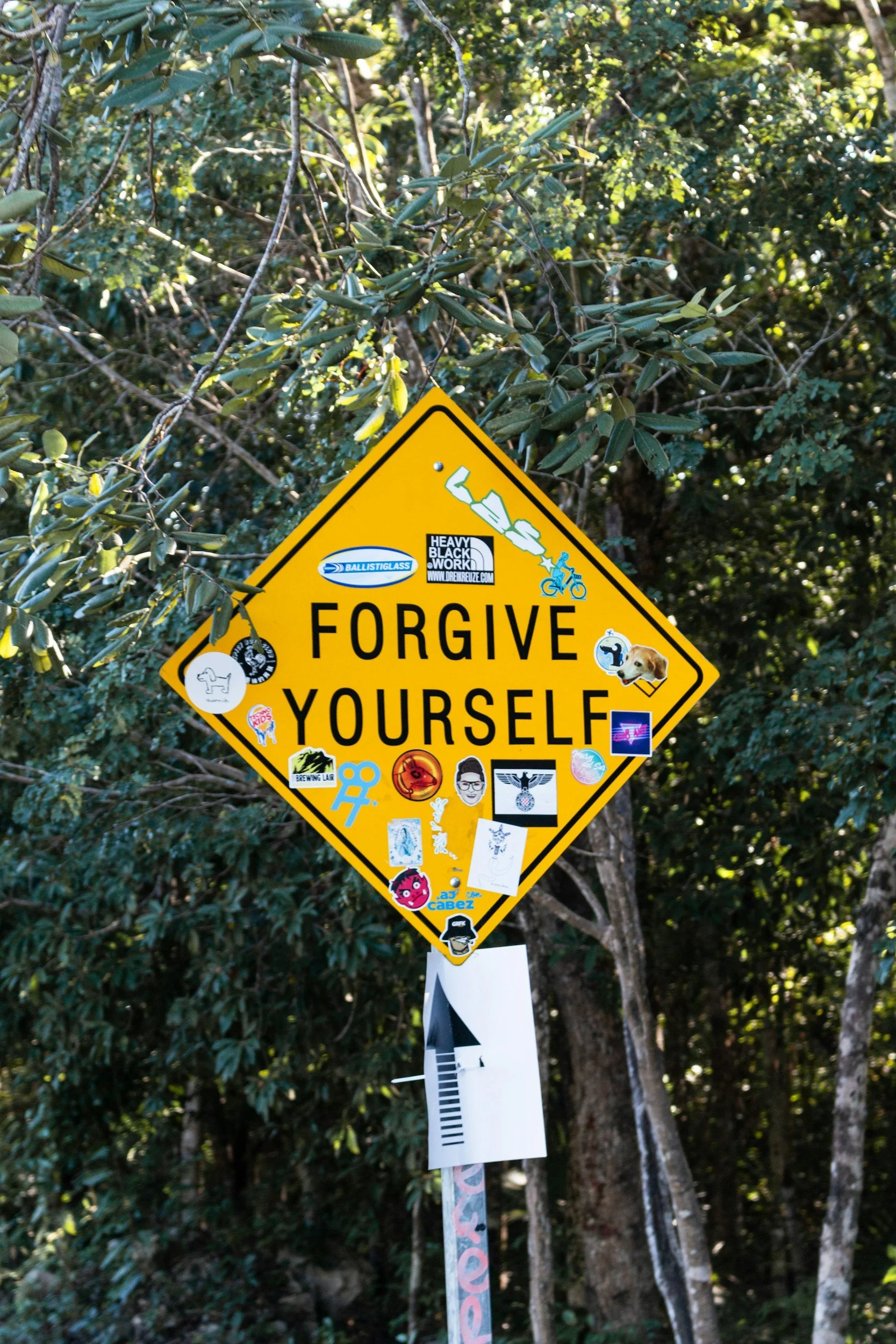
Self-forgiveness is more than a mantra (and yes — more than “I forgive myself”)
Saying the words “I forgive myself” can be helpful, but true self-forgiveness is usually a process that includes:
Acknowledgement — recognizing what happened without denial.
Taking responsibility — owning actions where appropriate (without toxic self-blame for things out of your control).
Making amends — when possible, repairing harm or committing to change.
Self-compassion — treating yourself the way you’d treat a friend.
Integration — learning, changing behavior, and letting the past inform but not define you.
Multiple intervention studies and systematic reviews find structured therapeutic approaches (not just pep talks) help people move through these steps toward true self-forgiveness.
Symbolic effort: rituals that actually help (and why)
Humans are meaning machines. Symbolic acts work because they embed psychological processes in behavior — they make change tangible. Examples therapists recommend:
Write an honest letter to yourself (then keep it or ceremonially close it).
Create a small ritual of release (e.g., safely burning a note, flushing a symbolic item, or planting something new).
Make a reparative list — practical steps you’ll take to make amends or avoid repeating harm.
Art or movement — drawing, sculpting, or a “forgiveness walk” that marks emotional transition.
Publicly (or privately) apologize when appropriate — then track the changes you make.
These symbolic steps matter because they combine accountability, intention, and a sensory experience that helps the brain move on. Think of them as emotional economy — invest a small ritual, get a big psychological return.
Therapies that reliably help people forgive themselves
A range of evidence-based therapies target self-criticism, shame, and self-forgiveness. Here’s how some of them help:
Cognitive Behavioral Therapy (CBT) — helps identify and re-structure harsh self-talk and behavioral patterns (practical, skills-based).
Compassion-Focused Therapy (CFT) — explicitly targets shame and self-criticism by developing self-compassion and a “soothing system.” Studies show CFT reduces self-criticism and improves self-forgiveness and psychological health.
Acceptance and Commitment Therapy (ACT) — teaches acceptance of painful feelings and commits to values-based action; useful for reducing rumination and harsh self-judgment.
Internal Family Systems (IFS) — works with “parts” of the self (the critic, the wounded child, the protector) to cultivate internal compassion and unburden shame; growing evidence supports IFS for trauma-related issues.
EMDR (Eye Movement Desensitization and Reprocessing) — often used for trauma; by processing traumatic memories, EMDR can reduce shame and self-blame tied to those memories.
Group therapy & forgiveness interventions — structured forgiveness programs and group formats can speed up gains and reduce isolation; systematic reviews show several approaches improve self-forgiveness.
If you want homework from therapy that actually works: expect practice (not platitudes). Therapies above typically include guided exercises, mindfulness, behavioral experiments, and sometimes role-playing — the real stuff of change.
Resentment: why we often point the finger outward when the wound is inward
People commonly project resentment onto others — “They ruined my life!” — when the ongoing anger is actually tethered to self-blame or unresolved shame. Research into forgiveness shows that letting go of resentment reduces anxiety and depression and improves relationships. In many cases, what looks like anger at someone else is a defensive way to avoid admitting the pain and disappointment we hold about ourselves. Working through that involves both boundary-setting (sometimes the other person actually did hurt you) and self-repair work.
Quick science bites (for people who like sources and bragging rights)
A meta-analytic review found meaningful correlations between self-forgiveness and psychological well-being across thousands of participants — a signal that forgiving yourself isn’t just airy-fairy; it’s associated with real mental health benefits.
Research links high self-criticism to increased risk for suicidal ideation and other serious outcomes — clinicians take self-criticism seriously because it predicts real danger.
Systematic reviews of interventions to promote self-forgiveness show multiple therapeutic methods (CFT, CBT, ACT, forgiveness programs) can help people move toward forgiveness in structured ways.
Practical (and slightly silly) do-it-today tools
The “Be Nice” Interruption: When you hear the critic start, say out loud, “Be nice.” Yes, out loud. It’s awkward and effective.
Micro-amends: One tiny reparative action per day (a text, a volunteer hour, a correction) — small behavior + time = re-wiring.
The Apology Audit: Write apologies you owe (if any), then schedule one small step this week to act on one.
A gentle mantra: “I did what I could with what I knew.” Add a ridiculous dance move after saying it to make your nervous system relax.
Ritual release: Write a short note about what you’re letting go of, then tear or burn it in a safe way (or, if you’re a plant person, bury it and plant something). Symbolic and oddly satisfying.
When to seek professional help (yes, we’re biased — but rightfully so)
If self-criticism is interfering with work, relationships, or your ability to get out of bed; if it’s tied to trauma; or if you’re noticing self-harm thoughts — reach out to a licensed clinician. Evidence-based therapies can dramatically reduce self-criticism and increase self-forgiveness. Undefeated Healthcare has providers licensed in Virginia, Maryland, and West Virginia who work with these issues — and we take the inner critic’s threats to heart (so we can laugh about them later, together).
Closing note (and a little tough love that’s actually kind)
Self-forgiveness is not an excuse; it’s the fuel for becoming better. It asks for honesty, repair where needed, and radical kindness to yourself. It’s less a one-time magic spell and more a refusal to keep making the same person you’ve always been — your prisoner.
If your inner critic ever challenges you to a duel, show up, but bring compassion, not a sword. And maybe a ridiculous hat. Healing doesn’t always have to be grim — sometimes it’s funny, human, and surprisingly gentle.
Want to connect with a therapist? Contact us:
